In order to get back at Dan for wrongs I will not specify on this website, I have eaten all of his hummus.
Yeah, that's right, Dan. Go check the fridge. I ate all of your hummus. What are you going to do about it?
Tuesday, January 09, 2007

All is Fair in Love and Finals
1. I woke up at 2:00pm today.
2. I went to bed at 6:00am last night. Er, morning.
3. The other day, I ran out of clean socks. To put off laundry for one day, I wore my blue soccer socks. The kind you wear over your shinguards and that extend to the knee. No one noticed.
4. I can't believe I never thought of this in college.
6. For real, no joke.
7. If all else fails on my exams, I will use the Chewbacca Defense.
8. I'm calling it an early night and going to bed now.
2. I went to bed at 6:00am last night. Er, morning.
3. The other day, I ran out of clean socks. To put off laundry for one day, I wore my blue soccer socks. The kind you wear over your shinguards and that extend to the knee. No one noticed.
4. I can't believe I never thought of this in college.
5. Did you know that the right to counsel in Miranda is derived from the 5th Amendment privilege against self-incrimination and not the 6th Amendment?
6. For real, no joke.
7. If all else fails on my exams, I will use the Chewbacca Defense.
8. I'm calling it an early night and going to bed now.
Friday, January 05, 2007
Losing Afghanistan
Reading alot about Iraq in the headlines, I didn't quite realize just how bad the situation is Afghanistan. According to this sobering article in Foreign Affairs, the Taliban is resurgent, conducting attacks with increasing sophistication (often using methods imported from Iraq), erecting a system of courts parallel to the government's, and openly operating out of Quetta, a provincial capital in Pakistan. Here's the kicker: Pakistan's intelligence agency, the Inter-Services Intelligence (ISI), is actively supporting the Taliban leadership.
Concludes Newsweek's Fareed Zakaria: "Afghanistan is in danger of becoming a version of Iraq, where the central government has collapsed, disorder is rife and a Qaeda-backed insurgency controls large swathes of the country."
The problem? Not enough troops and equipment. And the NATO-led troops that are there often have to operate under crippling rules of engagement that their individual countries impose upon them. As this op-ed in the Financial Times explains, even after the most recent NATO summit in Riga, only the Americans, British, Canadians, Dutch and Australians are allowed to fight in the most dangerous areas of Aghanistan--countries like Germany, France, Italy and Spain have only agreed to enter these areas to assist allies in the case of an "emergency."
But the problems aren't just military. Other indications suggest that the international aid operation is just as big of a disaster. The Foreign Affairs piece refers to "poorly designed and coordinated technical assistance," and donor organizations that insist on sending their own technical advisers from abroad that are clueless to the conditions on the ground.
I read the most blistering critique of the aid operation in Afghanistan in The Places in Between, a brilliant book written by a young Scotsman, Rory Stewart, who had the gall (and something else that rhymes with "gall") to walk across Afghanistan in January 2001, just weeks after the Taliban fell. As someone who was thoroughly familiar with Middle Eastern and Central Asian languages and cultures, Stewart had this to say about the flood of young aid administrators and bureaucrats who entered Afghanistan:
...They were mostly in their late twenties or early thirties, with at least two degrees--often in international law, economics, or development. They came from middle-class backgrounds in Western countries, and in the evenings, they dined with each other and swapped anecdotes about corruption in the government and the incompetence of the United Nations. They rarely drove their SUVs outside Kabul because their security advisers forbade it.
Some...were experienced and well informed about conditions in rural Afghanistan. But they were barely fifty out of many thousands. Most of the policy makers knew next to nothing about the villages where 90 percent of the Afghan population lived... [They] did not have the time, structures, or resources for a serious study of an alien culture. They justified their lack of knowledge and experience by focusing on poverty and implying that dramatic cultural differences did not exist.
Stewart packs the harshest and certainly most "gallsy" part of his critique in a footnote, where he states:
Critics have accused this new breed of administrators of neocolonialism. But in fact their approach is not that of a nineteenth-century colonial officer. Colonial administrations may have been racist and exploitative, but they did at least work seriously at the business of understanding the people they were governing. They recruited people prepared to spend their entire careers in dangerous provinces of a single alien nation...
Postconflict experts have got the prestige without the effort or stigma of imperialism. Their implicit denial of the difference between cultures is the new mass brand of international intervention. Their policy fails but no one notices. There are no credible monitoring bodies and there is no one to take formal responsibility. Individual officers are never in any one place and rarely in any one organization long enough to be adequately assessed... In fact their very uselessness benefits them. By avoiding any serious action or judgment they, unlike their colonial predecessors, are able to escape accusations of racism, exploitation, and oppression.
Whew. (It is important to know that after Afghanistan, Stewart put his money where his mouth was and served as a deputy provincial governor of Amarah and Nasiriyah after the Iraq invasion.) More troops may be on their way to Kabul, but the sort of problems described by Stewart will take much longer to fix.
Postscript: I would highly recommend Stewart's book. The section I quoted is perhaps the only "political" part; the rest is a beautiful and at times riveting travelogue. One moment he is commenting on the possible provenance of a mysterious ancient minaret; the next he is talking his way out of getting shot because his old adopted Aimaq fighting dog is considered unclean. A quick and enlightening read.
Concludes Newsweek's Fareed Zakaria: "Afghanistan is in danger of becoming a version of Iraq, where the central government has collapsed, disorder is rife and a Qaeda-backed insurgency controls large swathes of the country."
The problem? Not enough troops and equipment. And the NATO-led troops that are there often have to operate under crippling rules of engagement that their individual countries impose upon them. As this op-ed in the Financial Times explains, even after the most recent NATO summit in Riga, only the Americans, British, Canadians, Dutch and Australians are allowed to fight in the most dangerous areas of Aghanistan--countries like Germany, France, Italy and Spain have only agreed to enter these areas to assist allies in the case of an "emergency."
But the problems aren't just military. Other indications suggest that the international aid operation is just as big of a disaster. The Foreign Affairs piece refers to "poorly designed and coordinated technical assistance," and donor organizations that insist on sending their own technical advisers from abroad that are clueless to the conditions on the ground.
I read the most blistering critique of the aid operation in Afghanistan in The Places in Between, a brilliant book written by a young Scotsman, Rory Stewart, who had the gall (and something else that rhymes with "gall") to walk across Afghanistan in January 2001, just weeks after the Taliban fell. As someone who was thoroughly familiar with Middle Eastern and Central Asian languages and cultures, Stewart had this to say about the flood of young aid administrators and bureaucrats who entered Afghanistan:
...They were mostly in their late twenties or early thirties, with at least two degrees--often in international law, economics, or development. They came from middle-class backgrounds in Western countries, and in the evenings, they dined with each other and swapped anecdotes about corruption in the government and the incompetence of the United Nations. They rarely drove their SUVs outside Kabul because their security advisers forbade it.
Some...were experienced and well informed about conditions in rural Afghanistan. But they were barely fifty out of many thousands. Most of the policy makers knew next to nothing about the villages where 90 percent of the Afghan population lived... [They] did not have the time, structures, or resources for a serious study of an alien culture. They justified their lack of knowledge and experience by focusing on poverty and implying that dramatic cultural differences did not exist.
Stewart packs the harshest and certainly most "gallsy" part of his critique in a footnote, where he states:
Critics have accused this new breed of administrators of neocolonialism. But in fact their approach is not that of a nineteenth-century colonial officer. Colonial administrations may have been racist and exploitative, but they did at least work seriously at the business of understanding the people they were governing. They recruited people prepared to spend their entire careers in dangerous provinces of a single alien nation...
Postconflict experts have got the prestige without the effort or stigma of imperialism. Their implicit denial of the difference between cultures is the new mass brand of international intervention. Their policy fails but no one notices. There are no credible monitoring bodies and there is no one to take formal responsibility. Individual officers are never in any one place and rarely in any one organization long enough to be adequately assessed... In fact their very uselessness benefits them. By avoiding any serious action or judgment they, unlike their colonial predecessors, are able to escape accusations of racism, exploitation, and oppression.
Whew. (It is important to know that after Afghanistan, Stewart put his money where his mouth was and served as a deputy provincial governor of Amarah and Nasiriyah after the Iraq invasion.) More troops may be on their way to Kabul, but the sort of problems described by Stewart will take much longer to fix.
Postscript: I would highly recommend Stewart's book. The section I quoted is perhaps the only "political" part; the rest is a beautiful and at times riveting travelogue. One moment he is commenting on the possible provenance of a mysterious ancient minaret; the next he is talking his way out of getting shot because his old adopted Aimaq fighting dog is considered unclean. A quick and enlightening read.
How great is it that...
 ...Thomas Jefferson owned a copy of the Quran? Forget Obama. Raise that man from the dead and re-elect him. I can't imagine the 22nd Amendment applies to the undead.
Update: Dan has conducted some legislative interpretation on his own and has come to the conclusion that the 22nd Amendment "probably applies to dead people." Dan: "It all depends on the definition of 'person.' The amendment reads, "No person...". It doesn't read, "No living person," now does it?" Thanks Dan. Duly noted.
Wednesday, January 03, 2007
Quantic; The "Most Required" Llama
 Was surfing Cool Hunting yesterday instead of preparing for exams and discovered a great young artist, UK-based DJ/producer Quantic. His latest album, An Announcement to Answer caught my eye, and I quickly bought it on iTunes.
It's generally uptempo, and combines some eastern influences (check out Absence Heard, Presence Felt) with some older-school Latin stuff (Sabor) and some horn-friendly hip-hop that reminds me of Talib Kweli (Ticket to You Know Where). And some of it just plain rocks (Tell It Like You Mean It). I dig.
Random single you need to purchase on iTunes: You Fly Me by Fingathing. (You can listen to it on the crummy Amazon.com sample player, but you really should just drop the $0.99 and buy the thing.) I pulled this guy out of this pretty cool mix made by Stephane Pompougnac, a French DJ who is famous for the mixes he makes for Hotel Costes (no joke, that's actually the website), apparently the Parisian equivalent of the uber-chic Hudson Hotel.
Pompougnac, who is apparently two parts DJ and one part European-celebrity-metrosexual, has this hilarious over-the-top bio on him online that was written by someone who was remarkably close to being fluent in English. The money quote(s):
This is the real Stéphane Pompougnac, seen as an “urban neo-aristocrat” in Italy, as a “French signature DJ” in England, as Hotel Costes’ little prince turned “Baroque Olympus” in Germany, and hailed worldwide as the icon of New French Sophistication. Today he is DJing at Gucci, hopping from Bristol (where he plays at Massive Attack’s open bar) to Rio, working with Madonna (he remixed “What it feels like for a girl”), whirling Nicole Kidman at Cannes for the release of “Moulin Rouge” or performing at Cameron Diaz’s restaurant in Miami, the Bamboo Bar. Mixing jet lags and forever between planes...
[...]
Today, Stéphane is one of the most required DJ, spreading the music "à la française" all over the world.
What an ass. Though I have to admit it would be nice to be the "most required" something. And frankly I like the sound of mixing "jet lags and forever." Has the sound of a bad American Airlines-DeBeers joint promo.
Sunday, December 31, 2006
The Day I Met Saddam Hussein's Aunt
Saddam Hussein is dead. I don't want to make light of this occasion, but I also can't resist telling this story. So you remember that game, Six Degrees of Kevin Bacon? The idea was that you could link any actor to any other actor via a movie containing Kevin Bacon. Well, I don't want to promote Six Degrees of the Llama, but if you are reading this blog, and you happen to know the super-tippy-top-secret identity of the Llama, and in fact you personally know yours truly, then you my friend are just two degrees away from Saddam Hussein. Why? Cause many moons ago the Llama met, and had a lovely, if unsuspecting, conversation with Saddam Hussein's aunt. Or mother-in-law. It is unclear. To wit:
In 2004 I was working with my father on a research consulting project for an NGO. The work required us to conduct field research in Peru, Bolivia, and Paraguay, but in order to get to Paraguay from Peru one has to fly thru Argentina. Since we had family in Buenos Aires--and the NGO had a branch office where we could conduct some archival research--we decided to make a week-long stopover in BA.
At the time, my great uncle was serving as the Bolivian ambassador to Argentina. (The Llama may be but a humble camelid, but his ancestors roll deep.) He was on his way out, though--a new Bolivian president, Carlos Mesa, had come into office a few months earlier and had finally gotten around to appointing my uncle's successor.
Having heard of his upcoming departure, the diplomatic community organized a farewell cocktail party. It was held in the Buenos Aires Jockey Club, possibly the most pretentious building I've been in since I visited the offices of Cravath, Swaine, and Moore in New York. At least the Club didn't vaguely smell of sulfur, nor did it have the feeling that Darth Vader had just been chilling in the reception area. Wait, did I ever tell you about how Cravath has a budding human rights defense practice?
But I digress. Anyways, the day of the reception my father and I went to my uncle's apartment beforehand, where we met two aunts who would also be attending the reception. We arrived at the club fairly early, were given a brief tour of the premises, and then headed back to the main room. There were a couple of folks in the room already, so my uncle said hello and I kind of hung back with my dad.
The first forty-five minutes or so were uneventful. I basically talked with my dad and aunts, and occasionally went up to the random dignitary, introduced myself as Ambassador [Llama]'s nephew, made some chit-chat, then tracked down the family again.
In the course of the reception, though, I noticed that while most of the attendees were speaking in groups of three or more, two older women were not speaking to anyone else. One was short and had reddish-brown hair. The other one was very tall, fairly large, and had jet-black hair, the kind you only see when you are blind, or when you dye it with industrial strength, uh, hair dye. She also had a very large head.
I started paying attention to them, and continued to observe that they didn't approach anyone, and no one approached them. I thought that was weird, so I went over to talk to them.
"Hi. I'm Ambassador [Llama]'s nephew. I just thought I'd come over and say hello."
"Oooh, look at you, you're so cute," said that black-haired lady.
"He's so cute!" said the red-haired one, in slightlty less intelligible Spanish.
"Well, thank you. How nice of you to come to the reception. I'm sure that my uncle will be pleased to see you."
"Yes, this is nice," said the black-haired one.
"Very nice. This reception is nice," said the red-haired one.
"Uh, yes. May I ask where you are from?"
"We're from Jordan," they said in unison.
"Oh, wow. I understand you have a new king."
"You know about Jordan!"
"He knows about Jordan!"
Whereas before they had been fairly reserved and awkward, the two women simultaneously grabbed me by each arm and unleashed upon me a stream of praise (for my "knowing about Jordan") and information (about Jordan). It seemed as if no one had talked to them about their country in years. I explained to them that I had recently taken a course on Middle Eastern history and that I had read about the recent ascension King Abdullah, how he was a young king, and how he was pushing modernizing economic reforms.
They loved every minute of it. For every half-true fact that I spouted, their praise, and their attention to me only increased. Which was tough, cause they were really paying attention to me.
And I was right...kind of. Actually, I really had no idea what I was talking about. King Abdullah was young, but he had recently assumed power... five years ago. He was all about modernization, but he was also all about torture.
As I started to internally question my own expertise on the subject, though, and as the ladies continued to talk my ear off, I noticed something out of the corner of my eye. It was my dad, who was with my two aunts. All three of them were staring at me. My dad was laughing. I kept my eye on him and he kept on laughing, and then did that thing he does with his thumb and forefinger--Ali G does it when he says "booyakashah"--whenever he thinks something is either really worrisome or really funny.
Eventually, after promising that I would visit Jordan... someday... I was able to escape the All-Jordanian Fan Club. I walked back to my dad and asked him what was up.
"How was your conversation, hijo?"
"It was... nice. Those ladies are from Jordan."
"Jordan, huh?"
"Yes, they are very excited about Jordan."
"Yeah, well you know why no one's talking to them."
"Uh, no."
"Well, see that tall one, the one with the black hair?" The whole punchline has kind of been ruined by the wind-up, but rest assured that I was pretty surprised when my dad told me that I had just had a long, wonderful conversation with Saddam Hussein's aunt. Or mother-in-law, he wasn't sure. But he and my aunts were quite sure that she rolled with the big H, in a family way.
Anyway, there's not really a rousing end to this story. At the end, we all left the reception, and I don't remember saying bye to my Ba'athist friends. We weren't penpals, and though I don't think they forgot me immediately, I'm sure that the memory of me faded when someone showed them a map or article on Jordan, which I am sure has happened (probably) once in the past two years.
I will say, though, that I have spent a long time trying to find out exactly why my Ba'athist mystery lady was. Was she Saddam's aunt? Or was she his mother-in-law? I guess the punchline was that after a little research, I realized that it was possible--though unlikely--that she was Saddam Hussein's aunt and mother-in-law, 'cause Saddam's first wife--he is reported to have had three--was actually his first cousin. Ole.
In 2004 I was working with my father on a research consulting project for an NGO. The work required us to conduct field research in Peru, Bolivia, and Paraguay, but in order to get to Paraguay from Peru one has to fly thru Argentina. Since we had family in Buenos Aires--and the NGO had a branch office where we could conduct some archival research--we decided to make a week-long stopover in BA.
At the time, my great uncle was serving as the Bolivian ambassador to Argentina. (The Llama may be but a humble camelid, but his ancestors roll deep.) He was on his way out, though--a new Bolivian president, Carlos Mesa, had come into office a few months earlier and had finally gotten around to appointing my uncle's successor.
Having heard of his upcoming departure, the diplomatic community organized a farewell cocktail party. It was held in the Buenos Aires Jockey Club, possibly the most pretentious building I've been in since I visited the offices of Cravath, Swaine, and Moore in New York. At least the Club didn't vaguely smell of sulfur, nor did it have the feeling that Darth Vader had just been chilling in the reception area. Wait, did I ever tell you about how Cravath has a budding human rights defense practice?
But I digress. Anyways, the day of the reception my father and I went to my uncle's apartment beforehand, where we met two aunts who would also be attending the reception. We arrived at the club fairly early, were given a brief tour of the premises, and then headed back to the main room. There were a couple of folks in the room already, so my uncle said hello and I kind of hung back with my dad.
The first forty-five minutes or so were uneventful. I basically talked with my dad and aunts, and occasionally went up to the random dignitary, introduced myself as Ambassador [Llama]'s nephew, made some chit-chat, then tracked down the family again.
In the course of the reception, though, I noticed that while most of the attendees were speaking in groups of three or more, two older women were not speaking to anyone else. One was short and had reddish-brown hair. The other one was very tall, fairly large, and had jet-black hair, the kind you only see when you are blind, or when you dye it with industrial strength, uh, hair dye. She also had a very large head.
I started paying attention to them, and continued to observe that they didn't approach anyone, and no one approached them. I thought that was weird, so I went over to talk to them.
"Hi. I'm Ambassador [Llama]'s nephew. I just thought I'd come over and say hello."
"Oooh, look at you, you're so cute," said that black-haired lady.
"He's so cute!" said the red-haired one, in slightlty less intelligible Spanish.
"Well, thank you. How nice of you to come to the reception. I'm sure that my uncle will be pleased to see you."
"Yes, this is nice," said the black-haired one.
"Very nice. This reception is nice," said the red-haired one.
"Uh, yes. May I ask where you are from?"
"We're from Jordan," they said in unison.
"Oh, wow. I understand you have a new king."
"You know about Jordan!"
"He knows about Jordan!"
Whereas before they had been fairly reserved and awkward, the two women simultaneously grabbed me by each arm and unleashed upon me a stream of praise (for my "knowing about Jordan") and information (about Jordan). It seemed as if no one had talked to them about their country in years. I explained to them that I had recently taken a course on Middle Eastern history and that I had read about the recent ascension King Abdullah, how he was a young king, and how he was pushing modernizing economic reforms.
They loved every minute of it. For every half-true fact that I spouted, their praise, and their attention to me only increased. Which was tough, cause they were really paying attention to me.
And I was right...kind of. Actually, I really had no idea what I was talking about. King Abdullah was young, but he had recently assumed power... five years ago. He was all about modernization, but he was also all about torture.
As I started to internally question my own expertise on the subject, though, and as the ladies continued to talk my ear off, I noticed something out of the corner of my eye. It was my dad, who was with my two aunts. All three of them were staring at me. My dad was laughing. I kept my eye on him and he kept on laughing, and then did that thing he does with his thumb and forefinger--Ali G does it when he says "booyakashah"--whenever he thinks something is either really worrisome or really funny.
Eventually, after promising that I would visit Jordan... someday... I was able to escape the All-Jordanian Fan Club. I walked back to my dad and asked him what was up.
"How was your conversation, hijo?"
"It was... nice. Those ladies are from Jordan."
"Jordan, huh?"
"Yes, they are very excited about Jordan."
"Yeah, well you know why no one's talking to them."
"Uh, no."
"Well, see that tall one, the one with the black hair?" The whole punchline has kind of been ruined by the wind-up, but rest assured that I was pretty surprised when my dad told me that I had just had a long, wonderful conversation with Saddam Hussein's aunt. Or mother-in-law, he wasn't sure. But he and my aunts were quite sure that she rolled with the big H, in a family way.
Anyway, there's not really a rousing end to this story. At the end, we all left the reception, and I don't remember saying bye to my Ba'athist friends. We weren't penpals, and though I don't think they forgot me immediately, I'm sure that the memory of me faded when someone showed them a map or article on Jordan, which I am sure has happened (probably) once in the past two years.
I will say, though, that I have spent a long time trying to find out exactly why my Ba'athist mystery lady was. Was she Saddam's aunt? Or was she his mother-in-law? I guess the punchline was that after a little research, I realized that it was possible--though unlikely--that she was Saddam Hussein's aunt and mother-in-law, 'cause Saddam's first wife--he is reported to have had three--was actually his first cousin. Ole.
Wednesday, December 27, 2006
Holiday Movie Round-Up
With the holidays comes a hell of a lot of movie-watching.
The good:
 1. Fitzcarraldo (1982): Crazy German dude tries to build an opera house in the Peruvian Amazon. Doesn't end too well, but manages to lift steamboat across large swath of jungle, which is cool.
2. The Pursuit of Happyness (2006): Closest I've come to crying in a movie since The Chipmunk Adventure (1987). (If you're wondering, I lost it during the hot air balloon scene.)
The very good:
1. Das Boot (1981): Crazy German dude tries to pilot a U-boat in North Atlantic waters during World War II. Doesn't end too well, but that's probably a good thing since they're all Nazis.
2. The Spanish Prisoner (1997): Has nothing to do with a Spaniard who is a prisoner. Thriller with Usual Suspects-style plot and occasionally hilarious David Lynch-style dialogue. ("Why did you get me a Swiss bank account?" "Lavish awkward gesture.")
3. The Beat that My Heart Skipped (2005): Am aware that I've recommended this movie on here before, but just watched it again with the fam and was reminded how much it rocked. BTW, I'm offering $10 to whoever can figure out what music Tom is playing when the "Two Years Later" message comes on.
The bad:
1. Happy Feet (2006): Two hours of dancing penguins and no one does the worm? Uh-uh.
2. Blood Diamond (2006): I was previously under the the impression that my deep and abiding love for Jennifer Connelly would rescue any movie from the suck. I was wrong. Okay, it is a bit harsh to say that this movie sucked. I thought Jennifer Connelly was good.
The ugly:
1. Scarface (1983): I'm sorry, but I am so sick and tired of Al Pacino playing an Angry Man Who Screams A Lot. I actually almost put this in "The Bad" category because there was a certain comedic value in Tony Montana and his sidekick Manny, but all of this was erased the twentieth time he shot someone in the face while screaming the F-word. I did learn that cocaine used to go by "yeyo," though, which is the funnest term for a narcotic that I have heard in a while.
The good:
 1. Fitzcarraldo (1982): Crazy German dude tries to build an opera house in the Peruvian Amazon. Doesn't end too well, but manages to lift steamboat across large swath of jungle, which is cool.
2. The Pursuit of Happyness (2006): Closest I've come to crying in a movie since The Chipmunk Adventure (1987). (If you're wondering, I lost it during the hot air balloon scene.)
The very good:
1. Das Boot (1981): Crazy German dude tries to pilot a U-boat in North Atlantic waters during World War II. Doesn't end too well, but that's probably a good thing since they're all Nazis.
2. The Spanish Prisoner (1997): Has nothing to do with a Spaniard who is a prisoner. Thriller with Usual Suspects-style plot and occasionally hilarious David Lynch-style dialogue. ("Why did you get me a Swiss bank account?" "Lavish awkward gesture.")
3. The Beat that My Heart Skipped (2005): Am aware that I've recommended this movie on here before, but just watched it again with the fam and was reminded how much it rocked. BTW, I'm offering $10 to whoever can figure out what music Tom is playing when the "Two Years Later" message comes on.
The bad:
1. Happy Feet (2006): Two hours of dancing penguins and no one does the worm? Uh-uh.
2. Blood Diamond (2006): I was previously under the the impression that my deep and abiding love for Jennifer Connelly would rescue any movie from the suck. I was wrong. Okay, it is a bit harsh to say that this movie sucked. I thought Jennifer Connelly was good.
The ugly:
1. Scarface (1983): I'm sorry, but I am so sick and tired of Al Pacino playing an Angry Man Who Screams A Lot. I actually almost put this in "The Bad" category because there was a certain comedic value in Tony Montana and his sidekick Manny, but all of this was erased the twentieth time he shot someone in the face while screaming the F-word. I did learn that cocaine used to go by "yeyo," though, which is the funnest term for a narcotic that I have heard in a while.
Tuesday, December 26, 2006
Next Stop: New Year's
...and this is how I will be spending it.
Last summer I somehow ended up at a rave in a warehouse in deepest darkest Brooklyn. ("How do you know it was a rave?" Trust me.) It was, ahem, absurd. I am now on their email list and if this party is anything like that one, we--and anyone who chooses to join us--will be in for a treat.
Last summer I somehow ended up at a rave in a warehouse in deepest darkest Brooklyn. ("How do you know it was a rave?" Trust me.) It was, ahem, absurd. I am now on their email list and if this party is anything like that one, we--and anyone who chooses to join us--will be in for a treat.
Saturday, December 23, 2006
Kehinde Wiley

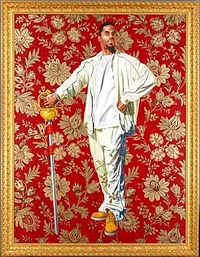 Yesterday, I went to the Virginia Museum of Fine Art. The hit of the visit was this recent acquisition (left) from Los Angeles-born and New York-based artist Kehinde Wiley. (To get an idea of its size--it is huge--click here.) Wiley, who is 28 (!), paints young, black men in poses reminiscent of Baroque or Rococo classics. In fact, the pose from Wiley's piece, Willem van Huythuysen (2006) is "quoted" directly from this 17th century portrait of a German gentleman of the same name (right). Wiley's portraits are in collections in Brooklyn, Denver, Kansas City, and of course, Richmond; an NPR profile recently described him as one of the "top newcomers on the New York art scene."
 When I first saw Willem, I thought it was a simple tongue-in-cheek take on flashy urban style. The more I thought about it, however, and the more I looked at his other work (which is best viewed at Wiley's personal website), I realized that the guy is doing something much more subtle--and valuable. First off, he's making fun of the arrogance of the original Renaissance-era paintings. If you look like a pompous ass standing like around with a sword (or a scroll, or a cane) in the 21st century, my guess is that you'd still look like a pompous jerk way back when.
Most importantly, though, Wiley is asking "Why not?" Why not portray young black men in traditional poses of wealth and power. Why can't they be the subjects of "serious" art work. I also love the fact that someone so young is able to make these points with such flair and style. The guy's currently exhibiting in Columbus, Ohio; definitely worth a look if that's your neck of the woods.
Post-script: If you're not too impressed by this particular piece and are wondering why I love this guy so much, I again recommend checking out the gallery in Wiley's website. That's where I found probably my favorite works of his, with his trademark bright--but spot-on and very attractive--color schemes and patterns.
Trouble Brewing in Bolivia; Hugo Chavez Wants In
I was at the Gutenberg Cafe in downtown Richmond today--nice, cosmopolitan little dig--and my mother pointed out this article in Le Monde about Bolivia. (No, I don't read Le Monde but am proud that someone in my family does.)
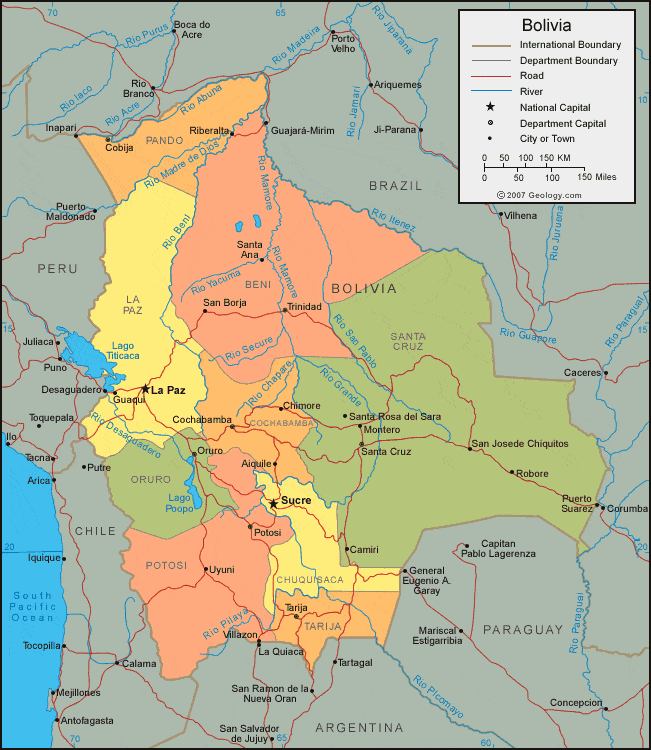
I haven't been following my South America news closely enough, 'cause major trouble is brewing in Bolivia. The provinces of Beni, Pando, Santa Cruz, and Tarija are all calling for increased autonomy from La Paz and the Evo Morales government; some people are calling for outright independence. There have been major protests, with dozens of people injured, and, to boot, Hugo Chavez in Venezuela has announced that his country will not "stand idle" at any action aimed at destabilizing the Bolivian government. In other words, that he'll send in troops.
Reuters has the best-English language coverage that I've found on the subject, but it is still lacking. This most recent article, for example, misleads as to the crux of the conflict. With the headline "Eastern Bolivians Vow To Intensify Autonomy Movement," you'd think that this was a regional conflict, an east-versus-west kinda thing. That whole idea breaks down when you look at a map of Bolivia and notice that two of the provinces calling for independence--Pando and Beni--are about as "Eastern" as Vermont is Deep South: they're not.
[This wasn't a journalistic blunder, though; the label "Easterners" comes from the fact Bolivians still refer to the Pando and Beni provinces--as north and west as they may be--as making up the "Oriente"--the "Orient" or "East."]
Rather, the conflict in Bolivia is race- and class-based. Bolivian President Evo Morales, while originally from a low-lying jungle area in central Bolivia (the Chapare), draws most of his support from collas--the name given to the predonominantly indigenous people from the highlands. Beni, Pando, Santa Cruz, and Tarija are home to the cambas--a population that is more European in ancestry and caucasian and mestizo in appearance.
The cambas, whose regions contain 96% of the Bolivia's massive natural gas reserves, are feeling increasingly distant and alienated from the Morales government. As the Reuters piece notes (but way too far down), "[m]any people in Santa Cruz feel they have little in common with the poor, mountainous west of the country, where Morales has his support base."
What now? Wait and see. But I know for a fact that folks in Bolivia are getting very nervous. It will be interesting to see if the U.S. will do or say anything if Chavez keeps up the rhetoric; something tells me it is AAI (All About Iraq) in the Oval for now.
Update: The New York Times just did a great piece on the Bolivia crisis. I agree with the article's diagnosis of the role of race--and natural gas--in the conflict.
I haven't been following my South America news closely enough, 'cause major trouble is brewing in Bolivia. The provinces of Beni, Pando, Santa Cruz, and Tarija are all calling for increased autonomy from La Paz and the Evo Morales government; some people are calling for outright independence. There have been major protests, with dozens of people injured, and, to boot, Hugo Chavez in Venezuela has announced that his country will not "stand idle" at any action aimed at destabilizing the Bolivian government. In other words, that he'll send in troops.
Reuters has the best-English language coverage that I've found on the subject, but it is still lacking. This most recent article, for example, misleads as to the crux of the conflict. With the headline "Eastern Bolivians Vow To Intensify Autonomy Movement," you'd think that this was a regional conflict, an east-versus-west kinda thing. That whole idea breaks down when you look at a map of Bolivia and notice that two of the provinces calling for independence--Pando and Beni--are about as "Eastern" as Vermont is Deep South: they're not.
[This wasn't a journalistic blunder, though; the label "Easterners" comes from the fact Bolivians still refer to the Pando and Beni provinces--as north and west as they may be--as making up the "Oriente"--the "Orient" or "East."]
Rather, the conflict in Bolivia is race- and class-based. Bolivian President Evo Morales, while originally from a low-lying jungle area in central Bolivia (the Chapare), draws most of his support from collas--the name given to the predonominantly indigenous people from the highlands. Beni, Pando, Santa Cruz, and Tarija are home to the cambas--a population that is more European in ancestry and caucasian and mestizo in appearance.
The cambas, whose regions contain 96% of the Bolivia's massive natural gas reserves, are feeling increasingly distant and alienated from the Morales government. As the Reuters piece notes (but way too far down), "[m]any people in Santa Cruz feel they have little in common with the poor, mountainous west of the country, where Morales has his support base."
What now? Wait and see. But I know for a fact that folks in Bolivia are getting very nervous. It will be interesting to see if the U.S. will do or say anything if Chavez keeps up the rhetoric; something tells me it is AAI (All About Iraq) in the Oval for now.
Update: The New York Times just did a great piece on the Bolivia crisis. I agree with the article's diagnosis of the role of race--and natural gas--in the conflict.
Dr. Spock Where Are You?
This video of a small South Asian child reciting the capitals of all fifty American states walks the fine line between creepy and really, really awesome. The head-on, dim greenish light, the heavy electrical wiring screen left, and the look on kid's face when they hit Kentucky all tend towards the former. The novel pronunciation (Texas? "As-THON!" Mississippi? "JACKH-son!") and the fact that everyone involved (kid, dad-cameraman, etc.) all seem to be mutually excited/obsessed with this, tend toward the latter.
Somehow, all of this reminds me of the time my brother and I went to see this Pearl Jam-cover band in Peru where the lead singer clearly and unabashedly did not speak English.
Somehow, all of this reminds me of the time my brother and I went to see this Pearl Jam-cover band in Peru where the lead singer clearly and unabashedly did not speak English.
Friday, December 22, 2006
And while I'm at it...
 Let me make another holiday gift recommendation: Hair Mayonnaise. You think I'm joking, but no, I was at CVS this morning to buy some hair stuff, and right where my normal stuff should be (American Crew Fiber, which I non-sarcastically recommend) was this big, tall $10 jar of "Hair Mayonnaise." I'm not sure what they do with their hair down here in the South, but if it requires something called "Hair Mayonnaise," boy am I glad that I acquired my personal grooming habits north of the Mason-Dixon line. It even says--right on the label--that it contains "Olive Oil, Egg Products & Herbs." It is actually mayonnaise. Anyways, I spent a good five minutes staring at the thing wondering if I could give this to my brother for Christmas, or if I thought it was funny enough--$10 funny--to purchase and keep in my bathroom as some sort of man-prop to keep my Yeti company. (The answer was no.)
Findlay Brown
So I was watching CSI with my mother tonight (another exciting holiday season!) and during the commercials this ad from MasterCard came on:
Just as it was about to end, I stopped whatever I was doing and thought, "Hey, that music actually sounds pretty good." I googled the only lyrics I could make out--"nobody ever says goodbye" and "come home"--and found out that the ad used the music of Findlay Brown, some sort of English-Danish country singer. The song itself was "Come Home."
Anyway, I spent the rest of the evening on the guy's MySpace site listening to "Come Home," "I Will," and "Separated by the Sea." I really like his sound; his voice is a cross of Samuel Beam (of Iron & Wine) and Chris Isaak, and his music is gentle but quite moving. This very well might be the first album I will actually, physically purchase in a long time...
Just as it was about to end, I stopped whatever I was doing and thought, "Hey, that music actually sounds pretty good." I googled the only lyrics I could make out--"nobody ever says goodbye" and "come home"--and found out that the ad used the music of Findlay Brown, some sort of English-Danish country singer. The song itself was "Come Home."
Anyway, I spent the rest of the evening on the guy's MySpace site listening to "Come Home," "I Will," and "Separated by the Sea." I really like his sound; his voice is a cross of Samuel Beam (of Iron & Wine) and Chris Isaak, and his music is gentle but quite moving. This very well might be the first album I will actually, physically purchase in a long time...
Thursday, December 21, 2006
Peer Pressure Wins the Day; the Llama Rides Again
Reports of my death are somewhat exaggerated. But after repeated encouragement/verbal harrassment from friends and colleagues, the Llama rides again.
AKK: So, I noticed you haven’t been posting much to your blog.
The Llama: Nope.
AKK: How come?
The Llama: It just takes too much time. You always have to be thinking about what you’re going to post next.
AKK: So I guess the “Q” in your name stands for “quitter”?
The Llama: I don’t have a “Q” in my name, Adam.
AKK: …
The Llama: …
AKK: I think the point stands.
The Llama: The whole thing also just degenerates into being a link monkey. Like: “Here’s a funny link.” “Here’s another funny link.” “Ha ha, click on this.”
AKK: But I like monkeys.
The Llama: So do I. In the zoo.
----
The Llama: Hey Sarah.
SB: Update your goddamn blog.
The Llama: What?
SB: That thing about Kahan is less funny every time I see it.
The Llama: That piece was supposed to be kind of weird and tragic, not funny.
SB: Really?
The Llama: No, but… you know. Tell you what. If you join me as a guest blogger, I’ll start blogging again.
SB: Nice try.
----
CH: Yo, dude, what happened to your blog? Update that shit.
The Llama: Okay.
AKK: So, I noticed you haven’t been posting much to your blog.
The Llama: Nope.
AKK: How come?
The Llama: It just takes too much time. You always have to be thinking about what you’re going to post next.
AKK: So I guess the “Q” in your name stands for “quitter”?
The Llama: I don’t have a “Q” in my name, Adam.
AKK: …
The Llama: …
AKK: I think the point stands.
The Llama: The whole thing also just degenerates into being a link monkey. Like: “Here’s a funny link.” “Here’s another funny link.” “Ha ha, click on this.”
AKK: But I like monkeys.
The Llama: So do I. In the zoo.
----
The Llama: Hey Sarah.
SB: Update your goddamn blog.
The Llama: What?
SB: That thing about Kahan is less funny every time I see it.
The Llama: That piece was supposed to be kind of weird and tragic, not funny.
SB: Really?
The Llama: No, but… you know. Tell you what. If you join me as a guest blogger, I’ll start blogging again.
SB: Nice try.
----
CH: Yo, dude, what happened to your blog? Update that shit.
The Llama: Okay.
Wednesday, November 15, 2006
Facts
1. If I were a renowned law professor, I would not devote a section of my personal webpage for my running times. If I were Dan Kahan, though, apparently I would.
2. When I grow up, I want to wear suits like this.
3. We have spent twice as much money rebuilding Iraq than we did rebuilding Japan in the seven years following WWII. We have spent almost as much as we did rebuilding Germany in the same period.
4. We have been in Iraq for three and a half years.
5. This is what my good friends Rufus and Gabe did in their spare time.
6. Coincidentally, Gabe also published the cover story in Science a couple of months ago.
7. I hefted an AK-47 in the evidence room down at the State’s Attorney’s office today.
8. Nope, not kidding. It had a bayonet on it.
9. “It is estimated that Americans now spend somewhere around $10 billion a year on adult entertainment, which is as much as they spend attending professional sporting events, buying music or going out to the movies.”
10. This is a really good poem about a cat.
2. When I grow up, I want to wear suits like this.
3. We have spent twice as much money rebuilding Iraq than we did rebuilding Japan in the seven years following WWII. We have spent almost as much as we did rebuilding Germany in the same period.
4. We have been in Iraq for three and a half years.
5. This is what my good friends Rufus and Gabe did in their spare time.
6. Coincidentally, Gabe also published the cover story in Science a couple of months ago.
7. I hefted an AK-47 in the evidence room down at the State’s Attorney’s office today.
8. Nope, not kidding. It had a bayonet on it.
9. “It is estimated that Americans now spend somewhere around $10 billion a year on adult entertainment, which is as much as they spend attending professional sporting events, buying music or going out to the movies.”
10. This is a really good poem about a cat.
Tuesday, November 07, 2006
Creepy Photo of the Day
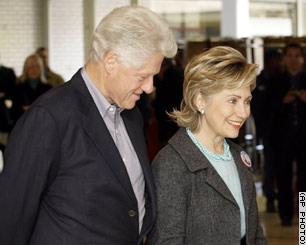 You fooled no one, Bill. Everyone knows that this morning you left Hillary at home and instead kidnapped Laura Bush, who may make a convincing Hillary but for that indelible nobody's-home/Baby-Ruuuth/"I like kittens!" face that she's got going on.
Nice try, though. At least she looks happy.
Monday, November 06, 2006
Llama still alive, chewing more grass
Hey folks,
Just want to let you know I haven't forgotten about the blog--just have been a bit more busy than usual! In general, I think that from now on I'll try to post every two or three days as opposed to every day. Less quantity, more super quality.
That said, tomorrow I'll be spending eight hours monitoring polls in deepest darkest Connecticut. I imagine I should have some stories to tell after that.
Go in peace,
The Llama
Just want to let you know I haven't forgotten about the blog--just have been a bit more busy than usual! In general, I think that from now on I'll try to post every two or three days as opposed to every day. Less quantity, more super quality.
That said, tomorrow I'll be spending eight hours monitoring polls in deepest darkest Connecticut. I imagine I should have some stories to tell after that.
Go in peace,
The Llama
Thursday, November 02, 2006
A Job I Hope I Never Have
Google is worried that as people start using the term "Google" as a generic verb--i.e. "I googled the guy to see what he had written"--Google will lose its claim on the Google trademark. (There are plenty of wrinkles, but common usage makes a trademark claim much harder to sustain.)
So... Google writes this entry on its "Official Google Blog" to try to discourage people from using the term "Google" so loosely. It was clearly written by some lawyer pretending to be a Google staffer who's funny! and exciting! but really concerned about this important trademark issue. I really hope I never have to do anything like this.
So... Google writes this entry on its "Official Google Blog" to try to discourage people from using the term "Google" so loosely. It was clearly written by some lawyer pretending to be a Google staffer who's funny! and exciting! but really concerned about this important trademark issue. I really hope I never have to do anything like this.
Why I Love Tom Waits
Friends have asked me about the “Music” section of my Facebook profile. In a list including the Arcade Fire, Sufjan Stevens, and some Latin American artists, one guy stands out—Tom Waits. Of all the folks on my list, he’s the one I know the least about: my knowledge of his music is mostly confined to The Mule Variations, with a couple of songs from Small Change, Rain Dogs, and a few other of his later albums. Here are a few reasons why this has been enough to convince me that the guy is a genius. (Click here to sample most of the songs referenced below.)
The first thing you’ll notice about Waits is his voice. I would say it is a cross between Louis Armstrong and Bob Dylan. Honestly, it sounds like the man gargles every morning with fresh gravel and motor oil.
But the guy is much more than a novelty voice. Waits has a remarkable ability to completely communicate a feeling: physical and emotional exhaustion in Pony, falling in love in Picture in a Frame, and being homesick, heartbroken, and probably drunk, in Tom Traubert’s Blues. And while many artists are good at doing this—someone like Nina Simone comes to mind—what makes Waits special is the manner in which he does it.
Check out his characters, for one. Waits' language is slow and spare, but when his banjo/guitar/out-of-tune-piano kicks in, two or three words conjure up an entire life.
Look at these lines from Pony, a song about a man’s travels around the country, and his deep desire to return home:
I run my race with burnt face Jake
Gave him a Manzanita cross
I lived on nothin’
But dreams and train smoke
Somehow my watch and chain
got lost.
I wish I was home
in Evelyn's Kitchen
With old Gyp curled around my feet
Don’t you kind of want Gyp curled around your feet? (And don’t you want to stay the hell away from “burnt face Jake”?) Better yet, though, some of Waits’ characters are just obscenely—and very entertainingly—out of their minds. Like in Chocolate Jesus. I kid you not, the song is about a man who, instead of going to church on Sundays goes to “Zerelda Lee’s candy store” and, well, eats himself a little candy Jesus. As Waits helpfully explains, “[w]hen the weather gets rough / and it’s whiskey in the shade / it’s best to wrap your savior up in cellophane.”
The best part thing about Waits, though, is his lyrics. By and large, Waits’ songs are not in your traditional first-person, this-happened, that-happened, now I’m happy/sad/nostalgic/in love/really frickin’ pissed off. Instead, while each song has some sort of narrative to it, it is also a mash-up of random sayings, touching—yet entirely out of place—moments, and ambient noise.
While you really have to listen to it, check out this verse from Hold On:
Well, he gave her a dimestore watch
And a ring made from a spoon
Everyone is looking for someone to blame
But you share my bed, you share my name
Well, go ahead and call the cops
You don't meet nice girls in coffee shops
She said baby, I still love you
Sometimes there's nothin’ left to do
Oh you got to hold on,
hold on
You got to hold on
Take my hand, I'm standing right here,
you got to just hold on.
“Well go ahead and call the cops / you don’t meet nice girls in coffee shops”? It makes no sense. But once you listen to the song you’re like “Yeah, go ahead and call the cops.” And its not cause you gained some context from the other verses. The whole thing just fits.
Other people have noticed, too. Do you like Downtown Train by Rod Stewart? Or Bruce Springsteen's Jersey Girl? Both covers of Waits originals. (And in my opinion, Waits’ Downtown Train makes Rod Stewart look like… Rod Stewart.)
Finally, though, since I’m realizing that none of this will really mean anything until you actually listen to Tom Waits, let me say I also get the impression that he is a huge badass.
That’s enough for now. Go listen to the guy.
Disclaimer: As I mentioned earlier, this post is based on a fairly narrow range of Tom Waits’ songs. For all I know, there’s probably ten albums in which he sings Kumbaya in contratenor to a tambourine and string quartet. But what I’ve heard, I either like, or just do not understand, so I’m sticking to my guns on this one.
The first thing you’ll notice about Waits is his voice. I would say it is a cross between Louis Armstrong and Bob Dylan. Honestly, it sounds like the man gargles every morning with fresh gravel and motor oil.
But the guy is much more than a novelty voice. Waits has a remarkable ability to completely communicate a feeling: physical and emotional exhaustion in Pony, falling in love in Picture in a Frame, and being homesick, heartbroken, and probably drunk, in Tom Traubert’s Blues. And while many artists are good at doing this—someone like Nina Simone comes to mind—what makes Waits special is the manner in which he does it.
Check out his characters, for one. Waits' language is slow and spare, but when his banjo/guitar/out-of-tune-piano kicks in, two or three words conjure up an entire life.
Look at these lines from Pony, a song about a man’s travels around the country, and his deep desire to return home:
I run my race with burnt face Jake
Gave him a Manzanita cross
I lived on nothin’
But dreams and train smoke
Somehow my watch and chain
got lost.
I wish I was home
in Evelyn's Kitchen
With old Gyp curled around my feet
Don’t you kind of want Gyp curled around your feet? (And don’t you want to stay the hell away from “burnt face Jake”?) Better yet, though, some of Waits’ characters are just obscenely—and very entertainingly—out of their minds. Like in Chocolate Jesus. I kid you not, the song is about a man who, instead of going to church on Sundays goes to “Zerelda Lee’s candy store” and, well, eats himself a little candy Jesus. As Waits helpfully explains, “[w]hen the weather gets rough / and it’s whiskey in the shade / it’s best to wrap your savior up in cellophane.”
The best part thing about Waits, though, is his lyrics. By and large, Waits’ songs are not in your traditional first-person, this-happened, that-happened, now I’m happy/sad/nostalgic/in love/really frickin’ pissed off. Instead, while each song has some sort of narrative to it, it is also a mash-up of random sayings, touching—yet entirely out of place—moments, and ambient noise.
While you really have to listen to it, check out this verse from Hold On:
Well, he gave her a dimestore watch
And a ring made from a spoon
Everyone is looking for someone to blame
But you share my bed, you share my name
Well, go ahead and call the cops
You don't meet nice girls in coffee shops
She said baby, I still love you
Sometimes there's nothin’ left to do
Oh you got to hold on,
hold on
You got to hold on
Take my hand, I'm standing right here,
you got to just hold on.
“Well go ahead and call the cops / you don’t meet nice girls in coffee shops”? It makes no sense. But once you listen to the song you’re like “Yeah, go ahead and call the cops.” And its not cause you gained some context from the other verses. The whole thing just fits.
Other people have noticed, too. Do you like Downtown Train by Rod Stewart? Or Bruce Springsteen's Jersey Girl? Both covers of Waits originals. (And in my opinion, Waits’ Downtown Train makes Rod Stewart look like… Rod Stewart.)
Finally, though, since I’m realizing that none of this will really mean anything until you actually listen to Tom Waits, let me say I also get the impression that he is a huge badass.
That’s enough for now. Go listen to the guy.
Disclaimer: As I mentioned earlier, this post is based on a fairly narrow range of Tom Waits’ songs. For all I know, there’s probably ten albums in which he sings Kumbaya in contratenor to a tambourine and string quartet. But what I’ve heard, I either like, or just do not understand, so I’m sticking to my guns on this one.
Are Ivy Leaguers Prude?
This Harvard student certainly isn't. But her classmates are prude enough to notice.
Subscribe to:
Posts (Atom)